The UCP Fulfillment Gap: What AI Shopping Agents Still Can't See
“Where’s my order?”
Soon, you’ll ask this question to an AI agent instead of hunting through email receipts or clicking through order status pages. Google, Shopify, and 20+ major retailers just made that future official.
But here’s what that conversation will sound like:
Hey, where's my order from Acme Store?
Your order is being processed. You'll receive tracking information when it ships.
...that's it?
Yes. The order status is 'processing.'
Not exactly helpful.
This isn’t a limitation of the AI. It’s a data problem. The agent is telling you everything it knows. The issue is that nobody’s feeding it anything better.
Google and Shopify just built the pipes. But for fulfillment, the pipes are waiting to be filled.
What Just Happened: UCP in 60 Seconds
On January 11, 2026, at NRF’s annual retail conference, Google and Shopify announced the Universal Commerce Protocol (UCP). Both CEOs were on stage. The partner list reads like a who’s who of commerce: Walmart, Target, Best Buy, Visa, Mastercard, Stripe, American Express, Adyen.
What it is: An open-source standard for “agentic commerce.” Think of it as HTTP for shopping. A universal protocol so AI agents (Google Gemini, ChatGPT, Microsoft Copilot) can browse, compare, and transact with any merchant backend without custom integrations.
The problem it solves: Before UCP, every AI shopping interface needed custom code for every merchant platform. That’s an N×N complexity nightmare. UCP collapses it into a single standardized interface.
How it works: Merchants publish a JSON manifest at /.well-known/ucp declaring their capabilities. AI agents query this endpoint to discover what a merchant supports, then interact through standardized APIs for checkout, payments, and order management.
The Google Developers Blog post calls it “a new open standard built for AI-first commerce experiences.” Shopify’s announcement frames it as “the infrastructure layer for the next decade of retail.”
They’re not wrong. This is foundational infrastructure.
But infrastructure needs data to flow through it.
The Fulfillment Blind Spot
All the UCP coverage focuses on the exciting parts: AI agents comparing products, negotiating prices, handling checkout, processing payments. That’s where the demo magic happens.
Nobody’s talking about what happens after checkout.
UCP has an Order capability for tracking fulfillment status. It includes a fulfillment.events[] array where merchants can push status updates. The spec even lists example event types: processing, shipped, in_transit, delivered.
Here’s the thing: the event type field is literally defined as “an open string field - businesses can use any values that make sense.”
That’s not a limitation. That’s brilliant protocol design. UCP doesn’t prescribe what data should flow through it. It just standardizes how to ask for data and how to receive it.
The problem is that the data most merchants can provide looks like this:
{
  "fulfillment": {
    "events": [
      { "type": "processing", "occurred_at": "2026-01-14T08:00:00Z" },
      { "type": "shipped", "occurred_at": "2026-01-15T17:30:00Z", "tracking_number": "794644790138" }
    ]
  }
}
Two events. Processing. Shipped. That’s it.
What happened in between? Where was the order for those 33 hours? Why did it take that long? Is that normal?
Nobody knows. The data doesn’t exist in the pipe.
The Black Box Problem
Here’s what fulfillment visibility actually looks like today:
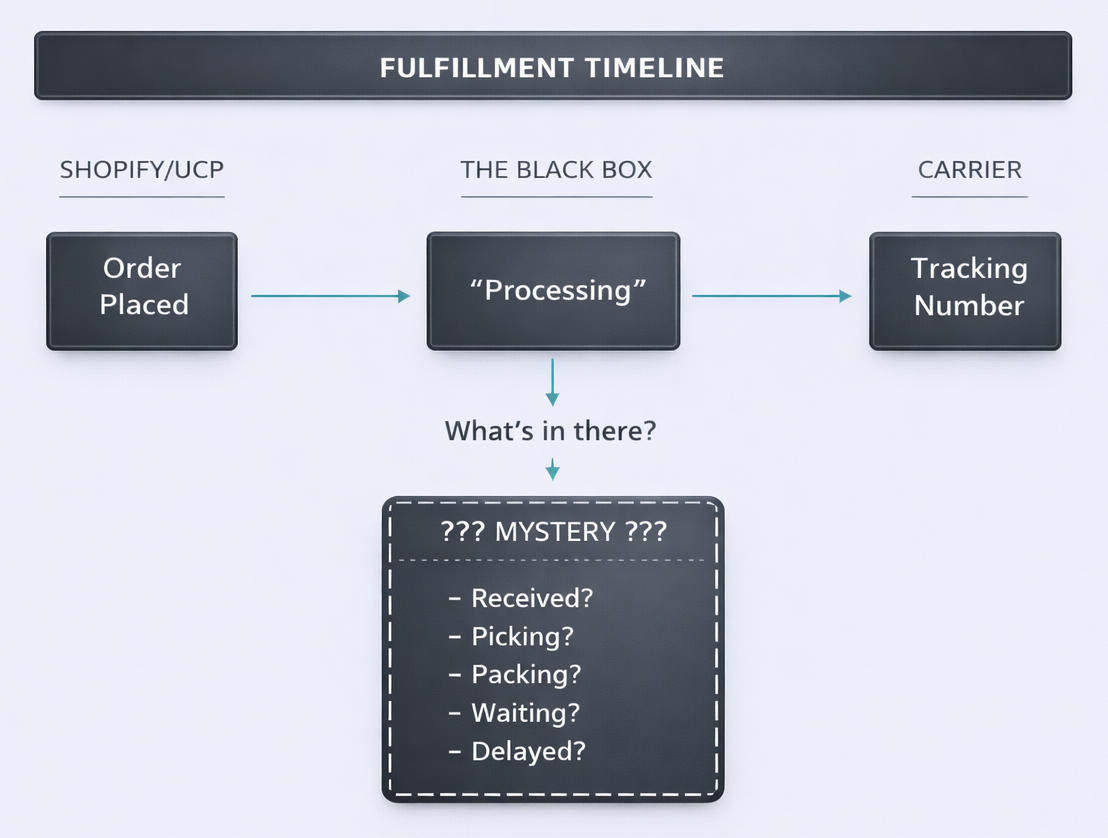
Shopify’s FulfillmentEventStatus enum starts at LABEL_PRINTED. Before that moment, the order is just “in progress.” No stages. No timestamps. No visibility.
But inside the 3PL warehouse, a lot is happening:
- Order received - The 3PL’s system acknowledges the order
- Inserted into WMS - Order enters the warehouse management queue
- Picking - Someone physically retrieves items from shelves
- Packing - Items are boxed with appropriate materials
- Labeling - Shipping label is generated and applied
- Staged - Package awaits carrier pickup
- Carrier pickup - Carrier scans and takes possession
That’s 6-7 distinct stages before “shipped.” Each has timestamps. Each can reveal problems. But none of this data flows to Shopify, to UCP, or to the AI agent trying to answer “where’s my order?”
The data exists. ShipBob has it. ShipHero has it. Deliverr has it. Every 3PL with a modern WMS tracks these stages internally.
It’s just trapped.
What an AI Agent Could Say (With Better Data)
Let’s revisit that conversation:
Today:
Where's my order?
Your order is being processed. You'll receive tracking when it ships.
With pre-label warehouse visibility:
Where's my order?
Your order was picked about an hour ago at the Cicero, IL warehouse and is currently being packed. It's on track to ship by 5 PM Central via FedEx Ground. You should have tracking within the next 2-3 hours, and delivery is estimated for Friday.
Same protocol. Same question. Completely different answer.
The difference isn’t smarter AI. It’s richer data.
The Two Gaps
UCP creates the opportunity for better fulfillment visibility. The protocol supports it. But two data gaps need to be filled:
Gap 1: Pre-Purchase (Delivery Confidence)
At checkout, you see shipping options like:
Standard Shipping: 5-7 business days ($5.00)
Express Shipping: 2-3 business days ($15.00)
What you don’t see:
- Actual 3PL processing time - This warehouse averages 1.5 days before carrier handoff
- Historical reliability - This 3PL + carrier combo is 87% on-time to your zone
- Current capacity - Holiday backlog is adding 1-2 days right now
- Fulfillment location - Ships from Chicago, not the closest warehouse
An AI agent helping you shop could use this data:
“Standard shipping estimates 5-7 days, but this merchant’s fulfillment has been running about 87% on-time during the holidays. If you absolutely need it by Friday, I’d recommend Express. It’s 98% reliable from their Chicago warehouse.”
That’s the kind of guidance that builds trust. But it requires data that doesn’t flow through UCP today.
Gap 2: Post-Purchase (Pre-Label Visibility)
The “where’s my order?” problem. Between checkout and tracking number, customers are in the dark. The order might be:
- Just received, hasn’t started processing
- Actively being picked
- Packed and waiting for carrier pickup
- Delayed due to inventory issue
- Stuck because of an address problem
All of these have different implications. All are knowable. None are visible through current UCP data.
What a UCP Fulfillment Extension Could Look Like
UCP is explicitly designed for extensions. The spec uses namespace-based extensibility: your domain equals your namespace. Anyone can create extensions without gatekeeping.
Here’s what a fulfillment visibility extension might look like:
Extension namespace: com.3plpulse.fulfillment
At checkout (pre-purchase confidence):
{
  "fulfillment": {
    "methods": [{
      "type": "shipping",
      "groups": [{
        "options": [
          {
            "id": "standard",
            "title": "Standard Shipping",
            "description": "Arrives Jan 20-23 via FedEx Ground",
            "totals": [{ "type": "total", "amount": 500 }],
            "com.3plpulse.delivery_confidence": {
              "on_time_rate": 0.87,
              "processing_days_avg": 1.5,
              "processing_days_p95": 2.5,
              "confidence": "medium",
              "fulfilling_warehouse": "Chicago, IL",
              "risk_factors": ["holiday_volume"]
            }
          },
          {
            "id": "express",
            "title": "Express Shipping",
            "description": "Arrives Jan 17-18 via FedEx Express",
            "totals": [{ "type": "total", "amount": 1500 }],
            "com.3plpulse.delivery_confidence": {
              "on_time_rate": 0.98,
              "processing_days_avg": 0.5,
              "confidence": "high",
              "fulfilling_warehouse": "Chicago, IL"
            }
          }
        ]
      }]
    }]
  }
}
Post-purchase (warehouse visibility):
{
  "id": "order_123",
  "fulfillment": {
    "expectations": [{
      "description": "Ships today, arrives Jan 17-18"
    }],
    "events": [
      { "type": "confirmed", "occurred_at": "2026-01-14T08:00:00Z" },
      { "type": "com.3plpulse.picked", "occurred_at": "2026-01-14T13:45:00Z" },
      { "type": "com.3plpulse.packed", "occurred_at": "2026-01-14T14:23:00Z" }
    ]
  },
  "com.3plpulse.fulfillment": {
    "provider": "ShipBob",
    "facility": {
      "code": "CHI1",
      "name": "Cicero, IL",
      "timezone": "America/Chicago"
    },
    "current_stage": "packed",
    "warehouse_timeline": [
      { "stage": "inserted", "occurred_at": "2026-01-14T08:15:00Z" },
      { "stage": "picked", "occurred_at": "2026-01-14T13:45:00Z" },
      { "stage": "packed", "occurred_at": "2026-01-14T14:23:00Z" }
    ],
    "estimated_ship_at": "2026-01-14T17:00:00Z",
    "carrier": "FedEx Ground",
    "sla_status": "on_track"
  }
}
This isn’t hypothetical protocol design. It’s what the data actually looks like when you pull it from ShipBob’s Timeline API or ShipHero’s webhooks. The events exist. The timestamps exist. They just need somewhere to go.
Who Needs to Build This?
The fulfillment visibility gap won’t close by itself. Someone needs to:
- Aggregate 3PL data - Normalize events from ShipBob, ShipHero, Deliverr, and others into a common format
- Define the extension schema - Publish specs that agents can understand
- Host the endpoints - Serve the data when agents query for it
- Keep it real-time - Push updates as warehouse stages progress
There are a few ways this could happen:
Shopify could build it. They already have Fulfillment Services integrations with major 3PLs. They could extend those integrations to pull richer timeline data and expose it through UCP. If anyone has the leverage to get 3PLs to open up their data, it’s Shopify.
3PLs could expose it directly. ShipBob, ShipHero, and others could publish their own UCP extensions. They have the data. But they’d need to agree on schemas, and their incentives are complicated. Better visibility might highlight performance issues they’d rather obscure.
Middleware could bridge it. Companies that already aggregate 3PL data could serve as the translation layer. Pull from multiple 3PL APIs, normalize into a common schema, expose via UCP extension. (Yes, that’s us. We’re already pulling this data from ShipBob, ShipHero, and others. If you’re working on this problem too, we’d love to compare notes .)
The protocol is ready. The data exists. The architecture is possible. It just needs someone to connect the pipes.
The Bigger Picture
UCP is a big deal. It’s the first serious attempt to standardize how AI agents interact with commerce, and the fact that Google, Shopify, and major retailers are aligned on it gives it real momentum.
But protocols are just plumbing. They enable data to flow, but they don’t create the data.
For product discovery, the data is already there. Catalogs exist. Prices exist. Reviews exist. UCP just standardizes how to access it.
For checkout, same story. Cart logic, tax calculations, payment processing - these systems already work. UCP wraps them in a standard interface.
For fulfillment, it’s different. The detailed data exists, but it’s fragmented across 3PLs, warehouses, and internal systems that were never designed to share. Nobody built the pipes to carry that water.
That’s the gap. UCP creates the opportunity. But turning “your order is processing” into “packed at Cicero, ships in 2 hours” requires someone to actually build the data layer.
We’ve been working on exactly this problem at 3PL Pulse - pulling pre-label warehouse events from 3PLs, normalizing them across providers, tracking SLAs, surfacing visibility that merchants and AI agents can actually use.
UCP gives that work a new destination. We’re excited to see where it goes.
Resources
UCP Official:
- UCP Specification - Full protocol documentation
- GitHub Repository - SDKs and reference implementations
Announcements:
- Google Developers Blog - Under the Hood
- Shopify News - AI Commerce at Scale
- Shopify Engineering - Building UCP
Shopify Fulfillment APIs:
News Coverage: